Blog > Tools/Resources > Graphic Design > D&AD Festival 2026: 5 Campaigns That Prove Creativity Is Alive

D&AD Festival 2026: 5 Campaigns That Prove Creativity Is Alive

·
8
min read
May 15, 2026
D&AD Festival 2026 graphic with yellow 3D D&AD logo and bold event text for Designity blog.
Table of Contents

D&AD has never been the place for safe ideas.

It’s where the work gets braver, the craft gets sharper, and the industry collectively remembers why great creative still gives us goosebumps.

Which makes the 2026 festival’s big question feel especially timely:

Is creativity dead or alive?

With AI filling feeds, pitch decks, and brainstorms faster than you can say “make it more premium,” it’s a fair question.

But the best D&AD-recognized work has always proved the same thing: tools change, taste matters, and a truly brilliant idea can still stop everyone in their tracks.

So, in this blog, we’re looking at five D&AD-recognized campaigns that prove creativity isn’t dead. It’s alive and kicking, folks!


What Is the D&AD Festival?

The D&AD Festival is one of the creative industry’s biggest gatherings for advertising, design, branding, film, digital, and creative technology.

Returning to London’s Southbank Centre on May 19–20, 2026, the festival brings together creatives, agencies, brands, and industry leaders. 


The two-day event features keynote talks, AI accelerators, jury insight sessions, learning labs, networking events, and the famous “Yellow Pencils: Why They Won” showcase breaking down award-winning work.


In short?
 

It’s part creative conference, part industry therapy session, and part inspiration overload.


Tickets for D&AD Festival 2026 are on sale now, with sessions starting from £30 ($35 as of May 15, 2026).


Who’s Speaking at the D&AD Festival in 2026?

The D&AD Festival speaker lineup is basically a creative industry group chat brought to life.

This year’s speakers include directors, global creative leaders, AI experts, branding icons, and some of the sharpest minds in advertising, design, media, and storytelling.


A few standout names include:

  • Gabriel Moses: Acclaimed photographer and film director known for cinematic work across fashion, sport, and culture.

  • NOVA DANDO: Global Creative Director at TikTok and jury member for Creator Content 2026.

  • Stefan Sagmeister: Legendary designer and creative thinker famous for pushing graphic design into experimental, emotional territory.

  • Karen Blackett CBE: Respected media leader and former UK President of WPP.

  • Nils Leonard: Founder of Uncommon Creative Studio and one of advertising’s most outspoken creative voices.

  • Mary Lewis: Branding and creative leader speaking on the future of creative thinking and communication.

  • Wesley ter Haar: Co-Founder and Chief AI Officer at Monks, bringing an AI-first perspective to modern creativity.


The Biggest Question of the Year at the 2026 D&AD Festival 

As AI continues to reshape nearly every industry, the creative world has found itself under increasing pressure. 

Designers, writers, illustrators, filmmakers, and creative directors are all asking the same questions: 


Will AI replace me? 

Will originality become harder to find in a world flooded with “slop”? 

Ultimately, is creativity dead?

D&AD took the matter seriously. Dead seriously.

This year, the festival built its entire narrative around one central question: Is creativity dead or alive? 

The campaign launched with a manifesto, quickly sparking a debate and turning the topic into a global conversation about the future of creativity, design, and art direction, and the role AI will play in all of it.


Our Take at Designity?

At Designity, we’re all for AI. Very all for it, actually.

Our client portal includes AI workflows that help make creative collaboration faster and more efficient, and our creative community actively integrates AI into the design process to explore directions, test ideas, and move smarter.

But our amazing Creatives and Creative Directors still polish the final deliverables.

Because AI can help open the door. It can speed up the process, expand the options, and make exploration easier.

But the taste, strategy, judgment, and big idea? 

That still comes from the people with the creative brains. 

And if D&AD’s history has taught us anything, unforgettable creative work has never been about the tool behind it. It’s about the idea in front of it.

So with D&AD Festival 2026 around the corner, we’re revisiting five Pencil-winning campaigns that may just answer the big question for us.


5 D&AD-Winning Campaigns That Prove Creativity Is Still Going Strong

These five D&AD-recognized campaigns prove that creativity is still alive, kicking, and finding brilliant new ways to make people look twice:


1. Makro: Life Extending Stickers
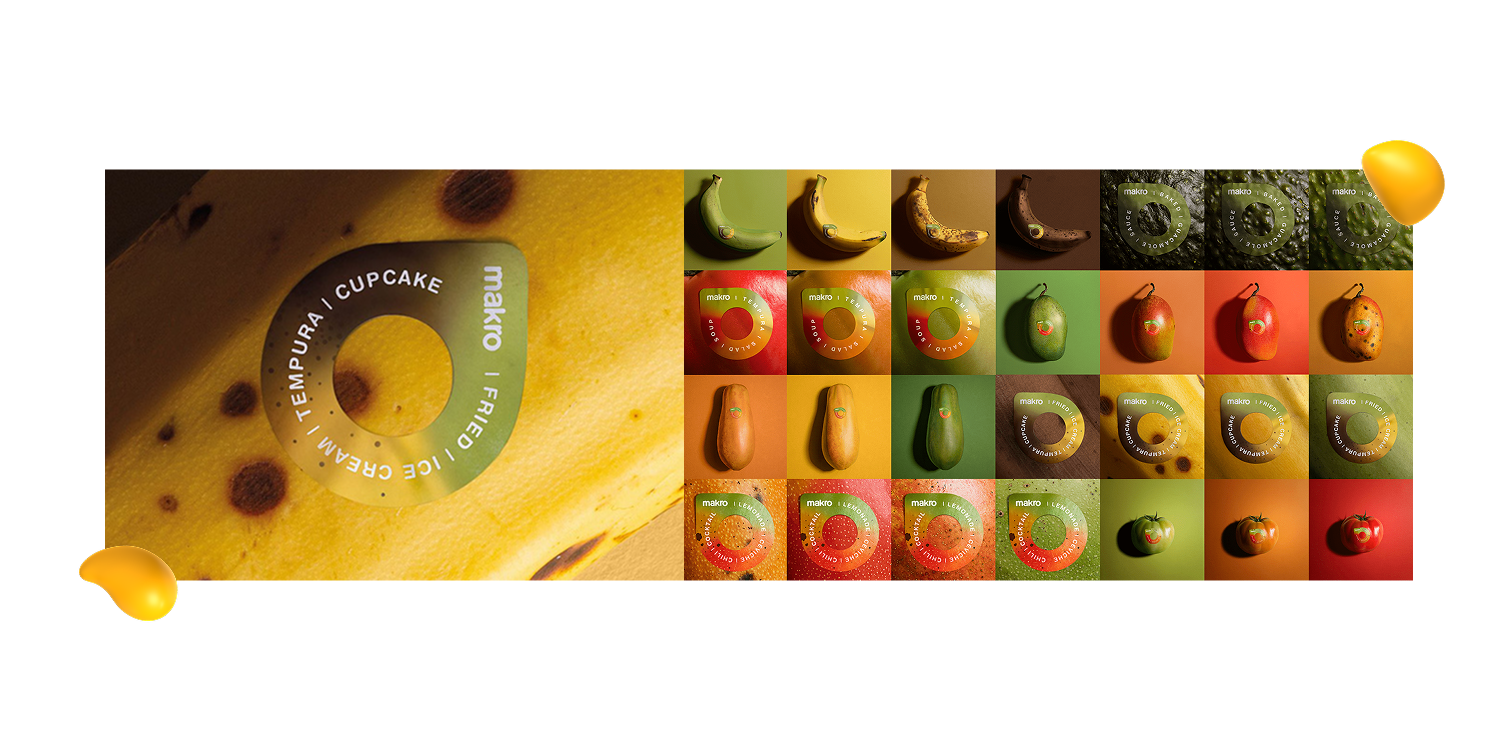
Sometimes the smartest creative ideas are sitting right in front of us. Literally.


The Insight

According to the UNEP, 9.76 million tons of food are wasted each year in Colombia alone. 

Makro Supermarkets wanted to tackle the problem both in-store and at home by helping shoppers better understand when produce was still perfectly usable.


The Execution

The brand transformed ordinary fruit stickers into a color-coded ripeness system showing where fruits and vegetables sat in their life cycle.

The stickers also suggested recipes based on ripeness level, encouraging people to cook with produce instead of throwing it away.

The idea was especially effective for produce in its most visually “imperfect” stages, when fruits and vegetables are often rejected for cosmetic reasons despite still being edible.


Why It Worked

The campaign reportedly reduced food waste by approximately 70 tons per week.

No fancy AI tools. No over-engineered tech solution. Just a simple sticker rethinking how people interact with food.

And honestly, that simplicity is exactly what made it brilliant.


2. Burger King: The Moldy Whopper
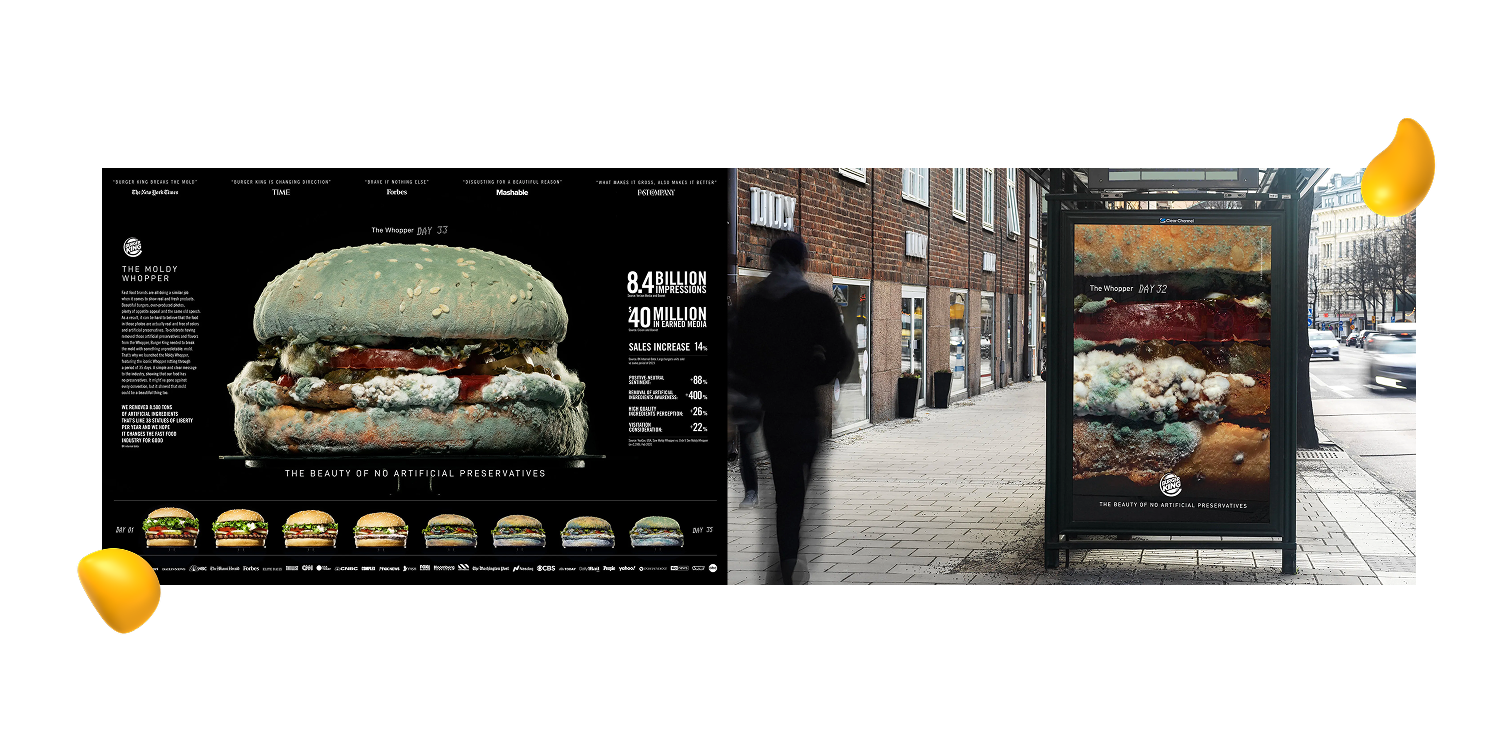
Most fast-food brands spend millions trying to make their burgers look eternal.

Burger King let theirs rot.


The Insight

At the center of the campaign was one uncomfortable but clever truth: spoilage can actually signal quality.

If a burger naturally decomposes, it suggests fewer artificial preservatives and additives are involved.


The Execution

Back in 2020, Burger King wanted to communicate its long-term commitment to removing artificial ingredients from its food, eliminating more than 8,500 tons of artificial preservatives globally over several years.

To bring that message to life, the brand documented a Whopper slowly growing mold over 35 days in a continuous time-lapse.

The visuals were intentionally unsettling. Which, of course, made them impossible to ignore.

Select frames from the process later appeared across print and out-of-home placements, extending the campaign into public spaces everywhere.


Why It Worked

The Moldy Whopper generated more than 2 billion impressions and contributed to a reported 4% lift in sales.

More importantly, it proved that bold creative risks still cut through.

Not because they’re optimized for algorithms, but because they tap into something human: curiosity, discomfort, surprise, and conversation.


3. Cheetos: The Other Hand
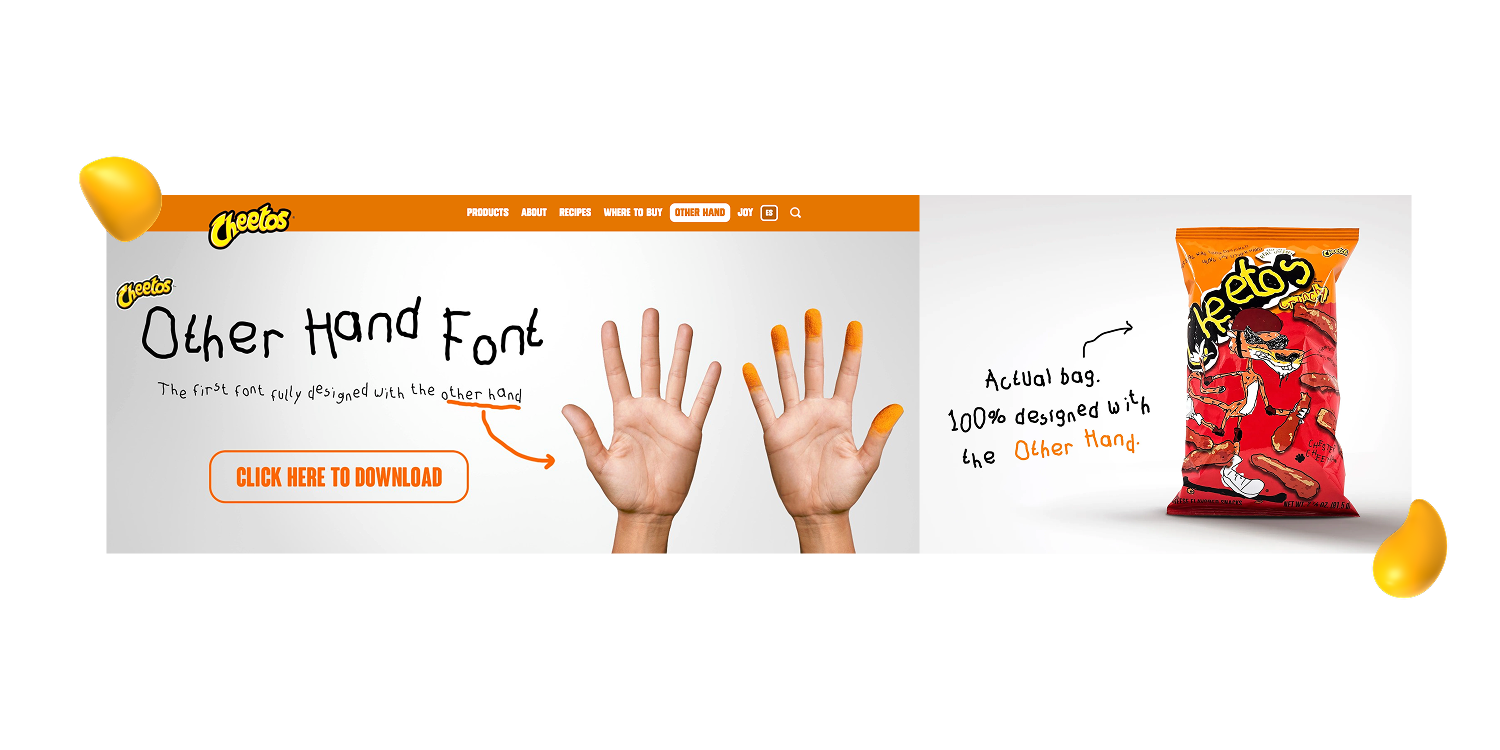
Every great campaign starts with a tiny human truth.

This one started with orange fingers.

The Insight

Anyone who has eaten Cheetos knows the problem immediately: once your hands are covered in bright orange dust, touching literally anything else feels irresponsible.

Instead of treating that as a flaw, Cheetos turned it into the entire creative platform.


The Execution

The packaging and campaign visuals were intentionally designed to look awkward, clumsy, and slightly “wrong,” as if they had all been created using the designer’s non-dominant hand.

Typography was uneven. Layouts felt off-balance. Illustrations looked messy on purpose.

Rather than hiding imperfection, the campaign fully embraced it.


Why It Worked

The campaign succeeded because it was rooted in a tiny behavioral truth millions of people instantly recognized.

No emotional manifesto. No complicated technology. Just a relatable insight exaggerated until it became funny.

The result sparked massive social engagement, memes, recreations online, and reinforced Cheetos’ playful identity without needing to over-explain the joke.


4. Coca-Cola: Recycle Me

Some campaigns scream for attention.

This one barely raised its voice.


The Insight

Coca-Cola realized recycling didn’t need a complicated explanation. It just needed to feel immediate, personal, and impossible to miss.


The Execution

Using nothing more than its iconic logo distorted into the shape of a crushed can alongside the headline “Recycle Me,” Coca-Cola created one of those rare ideas that feels painfully simple in hindsight.

No futuristic gimmicks. No interactive experience. No overbuilt storytelling system.

Just sharp art direction and an instantly understandable concept.


Why It Worked

What made the campaign stand out was its restraint.

Instead of positioning Coca-Cola as the hero of the sustainability story, the campaign subtly shifted responsibility toward consumer behavior itself.

It’s proof that great creative work doesn’t always need to invent something entirely new.


5. Heinz: It Has to Be…

Most brands spend years trying to make their logos bigger.

Heinz proved you can remove yours entirely.


The Insight

When a brand becomes culturally recognizable enough, audiences no longer need to explicitly see the name.


The Execution

The print series featured playful food pairings like “It has to be fries” and “It has to be bread,” with the final word shaped using the unmistakable silhouette and typography of the Heinz logo.


The word “Heinz” itself never actually appeared.


The campaign relied entirely on visual memory, cultural association, and decades of brand recognition doing the heavy lifting.


Why It Worked

The work felt smart because it trusted the audience.


No dramatic claims. No product demos. No oversized branding fighting for attention.


In a world obsessed with “make the logo bigger,” Heinz achieved impact by stripping almost everything away.


And somehow, the brand became even more recognizable because of it.
{{cd-led-team}}

So, Is Creativity Dead or Alive?

D&AD’s history makes the answer pretty obvious.


Creativity is alive, kicking (ass), and still coming up with better headlines than the first round.


Because great work isn’t remembered for the tool behind it.

It’s remembered for the thinking… the insight, the risk, the restraint, the humor, and the human touch.


That’s the kind of creativity Designity is built to support.


In our Creative Community, creatives don’t have to chase clients, manage timelines, or coordinate every moving piece alone. 


Our Creative Directors and Creative Project Managers guide the workflow, so creatives can choose projects that fit their strengths and focus on the work itself.


Join Designity’s creative community
today and keep your creativity alive and kicking.
Share this post:

Sara, a Designity content writer.
About the Author:
Hrista Tomova
Hrista is an award-winning Senior Creative Director with over nine years of experience helping brands across industries transform strategic ideas into impactful visual solutions.
Have a collab or partnership in mind? Reach out at marketing@designity.com

About Designity

Designity is a Creative-as-a-Service partner for marketing and creative leaders who need high-quality creative without the overhead of agencies or in-house teams. With top 3% creatives, Creative Director-led support, and flexible monthly plans, it’s a more cost-efficient way to scale.
Book a Demo Call
Get Insights From Designity
Table of Contents

More in Tools/Resources

Mobile App Design

No items found.

Marketing Advice

No items found.

Customer Marketing

No items found.

Demand Generation

No items found.

Corporate Marketing

No items found.

Creative Agency

No items found.

Augmented Reality

No items found.

ecommerce Design

No items found.

Social Media Marketing

No items found.

Industry Design

No items found.

Content Marketing

No items found.

Video Marketing

No items found.

Industry Marketing

No items found.

Design Services

No items found.

Jacob Cass

No items found.

eCommerce

No items found.

Financial Services

No items found.

Video Production

No items found.

Package Design

No items found.

OpenAI

No items found.

Web3

No items found.

Logo Design

No items found.

ChatGPT

No items found.

Digital Marketing

No items found.

Artificial Intelligence

No items found.

Creative Directors

No items found.

Trade Show

No items found.

Designity

No items found.

Recession

No items found.

Law Firm

No items found.

Freelance

No items found.

Motion Graphics

No items found.

Comparison

No items found.

In-House Teams

No items found.

Website Design

No items found.

Branding

No items found.

99Designs

No items found.

Staffing Agency

No items found.

Cryptocurrency

No items found.

Healthcare Design

No items found.

SaaS Design

No items found.

Blockchain

No items found.

Business Collateral Design

No items found.

Creative Teams

No items found.

Freelance Marketplace

No items found.

Creative Advice

No items found.

NFTs

No items found.

Graphic Design

No items found.

Copywriting

No items found.

Virtual Reality

No items found.

Team Building

No items found.

Tools/Resources

About Designity

Designity is a Creative-as-a-Service partner for marketing and creative leaders who need high-quality creative without the overhead of agencies or in-house teams. With top 3% creatives, Creative Director-led support, and flexible monthly plans, it’s a more cost-efficient way to scale.
Book a Demo Call
Get Insights From Designity
Your Designity creative team, against a yellow blog background.
About Designity
Designity is a virtual, on-demand creative and marketing agency that has been delivering flexible, scalable Creative-as-a-Service (CaaS) solutions since 2015. Each plan gives you instant access to an expert team made up of the top 3% fully vetted creatives, all led by a designated Creative Director, and supported by expert Project Managers and Marketing Strategists.

With 100+ services plus a brand-trained AI assistant to boost workflow efficiency, Designity gives you faster, more affordable results than traditional agencies or in-house teams. It’s everything you need to streamline your creative process and hit your marketing goals — on time, on budget, and always on brand.
cta-h-an
cta-g-an
cta-f-an
cta-e
cta-d
cta-c
cta-b
cta-a
Blog > Tools/Resources > Graphic Design > D&AD Festival 2026: 5 Campaigns That Prove Creativity Is Alive

D&AD Festival 2026: 5 Campaigns That Prove Creativity Is Alive

·
8
min read
May 15, 2026
D&AD Festival 2026 graphic with yellow 3D D&AD logo and bold event text for Designity blog.

D&AD has never been the place for safe ideas.

It’s where the work gets braver, the craft gets sharper, and the industry collectively remembers why great creative still gives us goosebumps.

Which makes the 2026 festival’s big question feel especially timely:

Is creativity dead or alive?

With AI filling feeds, pitch decks, and brainstorms faster than you can say “make it more premium,” it’s a fair question.

But the best D&AD-recognized work has always proved the same thing: tools change, taste matters, and a truly brilliant idea can still stop everyone in their tracks.

So, in this blog, we’re looking at five D&AD-recognized campaigns that prove creativity isn’t dead. It’s alive and kicking, folks!


What Is the D&AD Festival?

The D&AD Festival is one of the creative industry’s biggest gatherings for advertising, design, branding, film, digital, and creative technology.

Returning to London’s Southbank Centre on May 19–20, 2026, the festival brings together creatives, agencies, brands, and industry leaders. 


The two-day event features keynote talks, AI accelerators, jury insight sessions, learning labs, networking events, and the famous “Yellow Pencils: Why They Won” showcase breaking down award-winning work.


In short?
 

It’s part creative conference, part industry therapy session, and part inspiration overload.


Tickets for D&AD Festival 2026 are on sale now, with sessions starting from £30 ($35 as of May 15, 2026).


Who’s Speaking at the D&AD Festival in 2026?

The D&AD Festival speaker lineup is basically a creative industry group chat brought to life.

This year’s speakers include directors, global creative leaders, AI experts, branding icons, and some of the sharpest minds in advertising, design, media, and storytelling.


A few standout names include:

  • Gabriel Moses: Acclaimed photographer and film director known for cinematic work across fashion, sport, and culture.

  • NOVA DANDO: Global Creative Director at TikTok and jury member for Creator Content 2026.

  • Stefan Sagmeister: Legendary designer and creative thinker famous for pushing graphic design into experimental, emotional territory.

  • Karen Blackett CBE: Respected media leader and former UK President of WPP.

  • Nils Leonard: Founder of Uncommon Creative Studio and one of advertising’s most outspoken creative voices.

  • Mary Lewis: Branding and creative leader speaking on the future of creative thinking and communication.

  • Wesley ter Haar: Co-Founder and Chief AI Officer at Monks, bringing an AI-first perspective to modern creativity.


The Biggest Question of the Year at the 2026 D&AD Festival 

As AI continues to reshape nearly every industry, the creative world has found itself under increasing pressure. 

Designers, writers, illustrators, filmmakers, and creative directors are all asking the same questions: 


Will AI replace me? 

Will originality become harder to find in a world flooded with “slop”? 

Ultimately, is creativity dead?

D&AD took the matter seriously. Dead seriously.

This year, the festival built its entire narrative around one central question: Is creativity dead or alive? 

The campaign launched with a manifesto, quickly sparking a debate and turning the topic into a global conversation about the future of creativity, design, and art direction, and the role AI will play in all of it.


Our Take at Designity?

At Designity, we’re all for AI. Very all for it, actually.

Our client portal includes AI workflows that help make creative collaboration faster and more efficient, and our creative community actively integrates AI into the design process to explore directions, test ideas, and move smarter.

But our amazing Creatives and Creative Directors still polish the final deliverables.

Because AI can help open the door. It can speed up the process, expand the options, and make exploration easier.

But the taste, strategy, judgment, and big idea? 

That still comes from the people with the creative brains. 

And if D&AD’s history has taught us anything, unforgettable creative work has never been about the tool behind it. It’s about the idea in front of it.

So with D&AD Festival 2026 around the corner, we’re revisiting five Pencil-winning campaigns that may just answer the big question for us.


5 D&AD-Winning Campaigns That Prove Creativity Is Still Going Strong

These five D&AD-recognized campaigns prove that creativity is still alive, kicking, and finding brilliant new ways to make people look twice:


1. Makro: Life Extending Stickers

Sometimes the smartest creative ideas are sitting right in front of us. Literally.


The Insight

According to the UNEP, 9.76 million tons of food are wasted each year in Colombia alone. 

Makro Supermarkets wanted to tackle the problem both in-store and at home by helping shoppers better understand when produce was still perfectly usable.


The Execution

The brand transformed ordinary fruit stickers into a color-coded ripeness system showing where fruits and vegetables sat in their life cycle.

The stickers also suggested recipes based on ripeness level, encouraging people to cook with produce instead of throwing it away.

The idea was especially effective for produce in its most visually “imperfect” stages, when fruits and vegetables are often rejected for cosmetic reasons despite still being edible.


Why It Worked

The campaign reportedly reduced food waste by approximately 70 tons per week.

No fancy AI tools. No over-engineered tech solution. Just a simple sticker rethinking how people interact with food.

And honestly, that simplicity is exactly what made it brilliant.


2. Burger King: The Moldy Whopper

Most fast-food brands spend millions trying to make their burgers look eternal.

Burger King let theirs rot.


The Insight

At the center of the campaign was one uncomfortable but clever truth: spoilage can actually signal quality.

If a burger naturally decomposes, it suggests fewer artificial preservatives and additives are involved.


The Execution

Back in 2020, Burger King wanted to communicate its long-term commitment to removing artificial ingredients from its food, eliminating more than 8,500 tons of artificial preservatives globally over several years.

To bring that message to life, the brand documented a Whopper slowly growing mold over 35 days in a continuous time-lapse.

The visuals were intentionally unsettling. Which, of course, made them impossible to ignore.

Select frames from the process later appeared across print and out-of-home placements, extending the campaign into public spaces everywhere.


Why It Worked

The Moldy Whopper generated more than 2 billion impressions and contributed to a reported 4% lift in sales.

More importantly, it proved that bold creative risks still cut through.

Not because they’re optimized for algorithms, but because they tap into something human: curiosity, discomfort, surprise, and conversation.


3. Cheetos: The Other Hand

Every great campaign starts with a tiny human truth.

This one started with orange fingers.

The Insight

Anyone who has eaten Cheetos knows the problem immediately: once your hands are covered in bright orange dust, touching literally anything else feels irresponsible.

Instead of treating that as a flaw, Cheetos turned it into the entire creative platform.


The Execution

The packaging and campaign visuals were intentionally designed to look awkward, clumsy, and slightly “wrong,” as if they had all been created using the designer’s non-dominant hand.

Typography was uneven. Layouts felt off-balance. Illustrations looked messy on purpose.

Rather than hiding imperfection, the campaign fully embraced it.


Why It Worked

The campaign succeeded because it was rooted in a tiny behavioral truth millions of people instantly recognized.

No emotional manifesto. No complicated technology. Just a relatable insight exaggerated until it became funny.

The result sparked massive social engagement, memes, recreations online, and reinforced Cheetos’ playful identity without needing to over-explain the joke.


4. Coca-Cola: Recycle Me

Some campaigns scream for attention.

This one barely raised its voice.


The Insight

Coca-Cola realized recycling didn’t need a complicated explanation. It just needed to feel immediate, personal, and impossible to miss.


The Execution

Using nothing more than its iconic logo distorted into the shape of a crushed can alongside the headline “Recycle Me,” Coca-Cola created one of those rare ideas that feels painfully simple in hindsight.

No futuristic gimmicks. No interactive experience. No overbuilt storytelling system.

Just sharp art direction and an instantly understandable concept.


Why It Worked

What made the campaign stand out was its restraint.

Instead of positioning Coca-Cola as the hero of the sustainability story, the campaign subtly shifted responsibility toward consumer behavior itself.

It’s proof that great creative work doesn’t always need to invent something entirely new.


5. Heinz: It Has to Be…

Most brands spend years trying to make their logos bigger.

Heinz proved you can remove yours entirely.


The Insight

When a brand becomes culturally recognizable enough, audiences no longer need to explicitly see the name.


The Execution

The print series featured playful food pairings like “It has to be fries” and “It has to be bread,” with the final word shaped using the unmistakable silhouette and typography of the Heinz logo.


The word “Heinz” itself never actually appeared.


The campaign relied entirely on visual memory, cultural association, and decades of brand recognition doing the heavy lifting.


Why It Worked

The work felt smart because it trusted the audience.


No dramatic claims. No product demos. No oversized branding fighting for attention.


In a world obsessed with “make the logo bigger,” Heinz achieved impact by stripping almost everything away.


And somehow, the brand became even more recognizable because of it.
{{cd-led-team}}

So, Is Creativity Dead or Alive?

D&AD’s history makes the answer pretty obvious.


Creativity is alive, kicking (ass), and still coming up with better headlines than the first round.


Because great work isn’t remembered for the tool behind it.

It’s remembered for the thinking… the insight, the risk, the restraint, the humor, and the human touch.


That’s the kind of creativity Designity is built to support.


In our Creative Community, creatives don’t have to chase clients, manage timelines, or coordinate every moving piece alone. 


Our Creative Directors and Creative Project Managers guide the workflow, so creatives can choose projects that fit their strengths and focus on the work itself.


Join Designity’s creative community
today and keep your creativity alive and kicking.
Share this post:

Sara, a Designity content writer.
About the Author:
Hrista Tomova
Hrista is an award-winning Senior Creative Director with over nine years of experience helping brands across industries transform strategic ideas into impactful visual solutions.
Have a collab or partnership in mind? Reach out at marketing@designity.com

Share this post:

Back to top
Close icon